Benjamin Bagby
Vocalist, harper and scholar Benjamin Bagby has been an important figure in the field of medieval musical performance for more than 45 years. After musical studies in the USA (Oberlin Conservatory and Oberlin College) and Switzerland (Schola Cantorum Basiliensis), he and the late Barbara Thornton formed Sequentia in 1977 in Cologne, Germany, where the ensemble was based until Ms. Thornton's tragic death in 1998. Mr. Bagby moved to Paris in 2001.
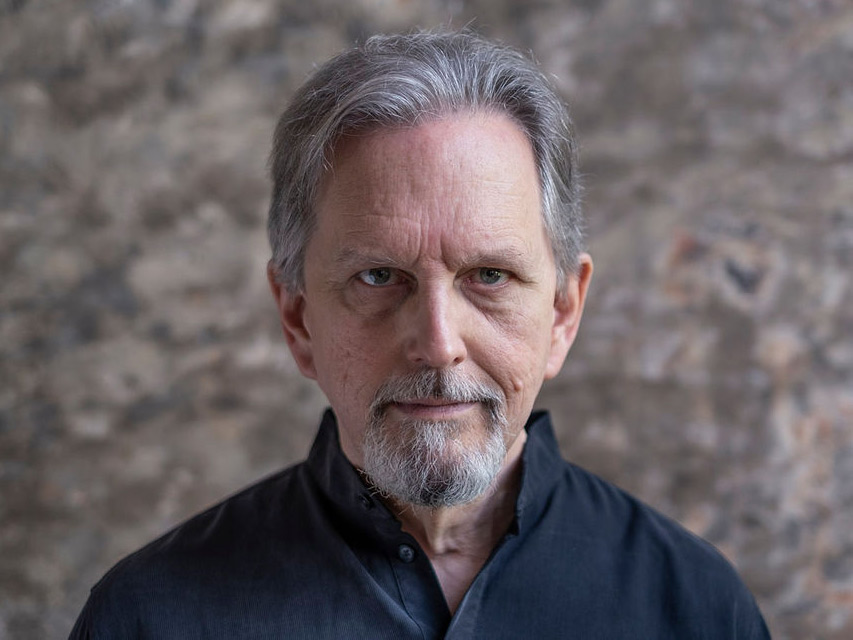
Benjamin Bagby
The years since 1977 have been almost uniquely devoted to the work of Sequentia. Mr. Bagby created more than 80 innovative concert programs of medieval music and music drama, giving performances in Western and Eastern Europe, North & South America, North and West Africa, the Middle East, Japan, Korea, and Australia.
In 1981, the ensemble began to release the first of many LP's and CD's which encompass the entire spectrum of medieval musical practice. Many of these recordings – including the complete works of Hildegard von Bingen (7 CDs) have received awards: the Deutsche Schallplattenpreis (for Vox Iberica, 1993), two Netherlands Edison Awards (for Hildegard von Bingen recordings, 1987 and 1998), a French Disque d'Or (1996), the CHOC of Le Monde de la Musique (2002) and Diapason d'Or (1995 and 1999). Sequentia's best-selling CD, Canticles of Ecstasy,has sold more than 500.000 copies worldwide and was nominated for a Grammy Award as best choral recording.
For all of these recordings, which were researched and assembled by Bagby and Thornton, the accompanying booklets are appreciated for their rigourous scholarly quality, with great attention to detail, to the sources, and to the work of philologists (such as Peter Dronke, Pierre Bec, Heimir Pálsson and Ulrich Mueller) who collaborated on the textual editions. In addition, Sequentia projects witnessed collaboration with musicologists such as Leo Treitler, Edward Roesner, Sam Barrett, Harmut Möller and Richard Crocker.
The most recent CD releases of Sequentia (Edda: Myths from Medieval Iceland; The Rheingold Curse; Lost Songs of a Rhineland Harper and Fragments for the End of Time) are based solely on the research of Benjamin Bagby, reflecting his interest in oral poetry and the use of traditional music in reconstructing ancient modal vocabularies. They are grouped under the banner 'The Lost Songs Project.' The project also includes his solo DVD performance of 'Beowulf' and the Sequentia CD Boethius: Songs of Consolation.
Bagby also directed the Sequentia men's vocal ensemble for the performance of medieval liturgical polyphony and chant, which traces it beginnings to the mid-1980's. The major project for the men's voices was a collaboration – entitled Chant Wars – between Sequentia and the Parisian ensemble Dialogos (dir., Katarina Livljanic). The CD of this program was released by Sony-BMG (DHM label) in 2005. In 2009, he created a new men's vocal ensemble in Paris, which toured extensively.
Apart from the research and ensemble work of Sequentia, Mr. Bagby devotes his time to the solo performance of Anglo-Saxon and Germanic oral poetry; an acclaimed performance of the Beowulf epic was an ongoing project (1990-2025), with performances given yearly worldwide, and a DVD production released in 2007.
In addition to reseaching and writing more than 80 program books for festivals and concert series, and writing (or co-authoring, with Barbara Thornton) more than 30 CD booklets, Mr. Bagby has written about performance practice, with articles appearing in Early Music, Early Music America, in the Performer's Guide to Medieval Music (IU Press) edited by Ross Duffin, in the Basler Jahrbuch für historische Musikpraxis, in the Cambridge History of Medieval Music (co-authored with Katarina Linljanic), and in a recent collection of essays, Performing Medieval Narrative. [See: Writings on medieval music].
As a guest lecturer and professor, he has taught courses and workshops at – among others – the Schola Cantorum Basiliensis, Harvard University, the Vancouver Early Music Festival, Autunno Musicale (Como, Italy), the Modus Centrum (Oslo), Amherst Early Music, Wellesley College, the University of Texas at Austin, Northwestern University, the New England Conservatory of Music (Boston), Sarah Lawrence College (NY), St. John's College (Santa Fe), Duke University, Stanford University, Madrid, Milano, the Studio Alte Musik (Berlin), the Royaumont Foundation (Paris) and the Stary Sacz Festival (Poland).
Bagby has been a guest speaker at New York University's Medieval Studies Program, and he spent a semester as a visiting Krieger Fellow at Case Western Reserve University (Cleveland); he was invited as Patten Lecturer at Indiana University (Humanities and School of Music), as a humanities lecturer (together with Ping Chong) at the University of Michigan, and was a guest professor at Illinois Wesleyan University (Bloomington, IL) HE was awarded a Fortieth Anniversary Fellowship by the Religion and the Arts Initiative (Center for the Study of World Religions, in conjunction with the Music Department) of Harvard University, where he and Katarina Livljanic spent 6 weeks in residence developing the program Chant Wars. He was a Trotter Distinguished Visiting Professor (University of Oregon) and – again together with Katarina Livljanic – he was a Cornille Distinguished Visiting Professor at Wellesley College. Bagby and Livljanic were visiting instructors at Harvard University.
In 2011 Bagby was awarded the Howard Mayer Brown Lifetime Achievement Award by Early Music America, and in 2017 he received the REMA (European Early Music Network) Award as 'Artist of the Year.'
Between 2005-2018 Bagby joined the music faculty of the Université de Paris - Sorbonne, teaching in the master's programme for medieval music performance. He subsequently taught medieval performance practice (2018-2025) in a master's program at the Folkwang Universität der Künste in Essen, Germany.