Beowulf – the Epic in Performance
Benjamin Bagby, Voice & Anglo-Saxon Harp
Benjamin Bagby's reconstruction of a scop's performance of the Beowulf epic opened the gate for the entire 'Lost Songs Project' which was to become so important in the decades to come. He developed the working model in the mid-1980's, from which all other projects were to be based. His performance has been acclaimed worldwide for over three decades, and was filmed in 2006. One of his performances, in New York City in 2020, was live-streamed by the 92nd Street Y and can be viewed here.
The Anglo-Saxon epic poem Beowulf survives in a single manuscript source dating from the early eleventh century (British Library, Cotton Vitellius A. XV). Although scholars do not agree on the dating of the poem — theories range between the sixth century and the date of the manuscript — it is clear that the story has its roots in the art of the scop ('creator'), the story-teller and reciter at formal and informal gatherings, whose services were essential to the fabric of tribal society in early medieval England. The scop would re-tell the story of Beowulf, in song and speech, perhaps accompanying himself on a six-stringed harp (this we know from contemporary accounts, although musical notation was superfluous and only remnants of instruments have survived). His courtly audience was attuned to the finest details of sound and meaning, metre and rhyme, timing and mood.
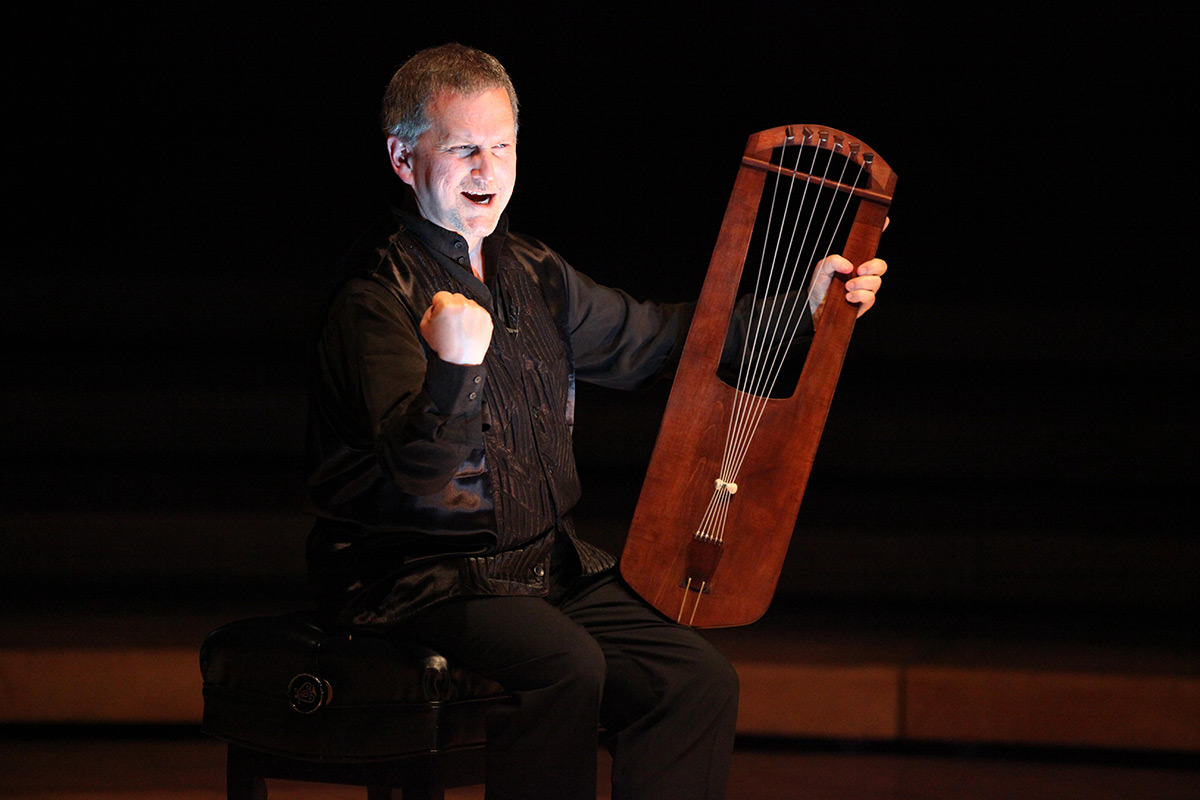
A performance of Beowulf. Photo: HillaryScott
The 'performance' — which, for the whole epic, might last five hours — would never be exactly the same twice, as the 'singer of tales' subtly varied the use of poetic formulæ to shape his unique version of the story. The fact is that the written source can only represent one version (and usually not the best version) of a text from a fluid oral tradition; it is the central dilemma of any attempt to re-vocalise a medieval text as living art. The impetus to make this attempt has come from many directions: from the power of those oral storytelling traditions, mostly non-European, which still survive intact; from the work of instrument-makers who have made thoughtful renderings of seventh-century germanic harps; and from those scholars who have shown an active interest in the problems of turning written words back into an oral poetry meant to be absorbed through the ear/spirit, rather than eye/brain. But the principal impetus comes from the language of the poem itself, which has a chilling, magical power that no modern translation — and there are dozens — can approximate.
The Instrument
The 6-string harp used in this performance was built in 1997 by Rainer Thurau (Wiesbaden, Germany), based on the remains of an instrument excavated from a 7th century Alemannic nobleman's grave in Oberflacht (south of Stuttgart). The remarkably intact pieces of oak clearly show a thin, hollow corpus with no soundholes. Like a similar instrument unearthed at Sutton Hoo in England, there are strong indications, supported by contemporary iconography, of six gut strings, a tailpiece and a free-standing bridge. This storyteller's instrument serves as a key piece of evidence in reconstructing the performance, for it provides a series of six tones. Although several possible tunings present themselves, the six tones used tonight were arrived upon through a careful study of early medieval modal theory, yielding an octave, three perfect 5ths, two perfect 4ths and two minor 3rds. The resulting 'scale' serves as a musical matrix, upon which the singer can weave both his own rhetorical shapes and the sophisticated metrics of the text (each line, divided into two halves, contains 4 stresses which are linked by a common vowel or consonant sound).
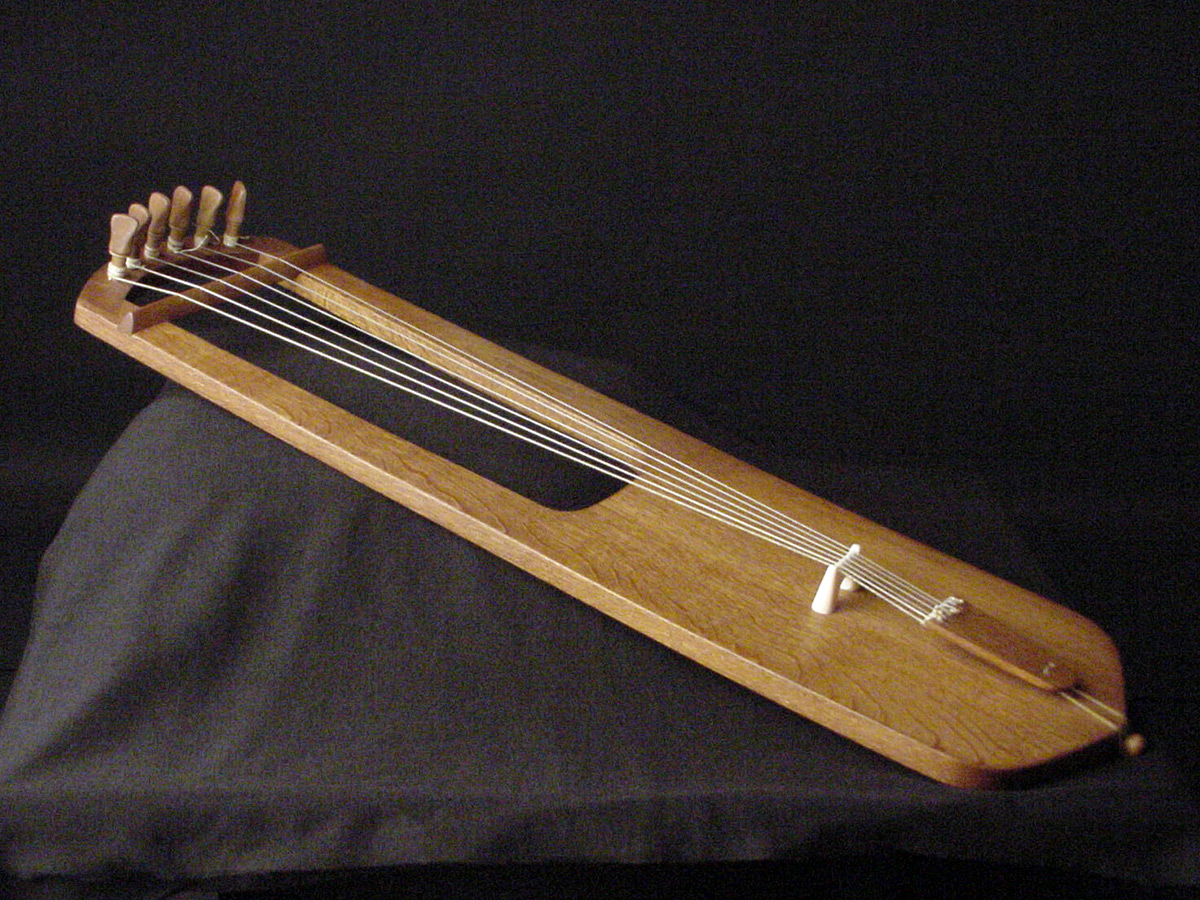
The harp built by Rainer Thurau
The Anglo-Saxon ear was finely-tuned to this web of sounds and syllable lengths; it was always experienced as an aural event, inextricably bound up with the story being told. The harp is a relatively quiet instrument, but in the ear of the performer it rings with an endless variation of gestures, melodic cells and repetitive figurations which give inspiration to the shape of the vocalization: in the course of the story the performer may move imperceptibly or radically between true speech, heightened speech, speech-like song, and true song. The instrument acts as a constant point of reference, a friend and fellow-performer, a symbol of the scop and his almost magical role in the community.
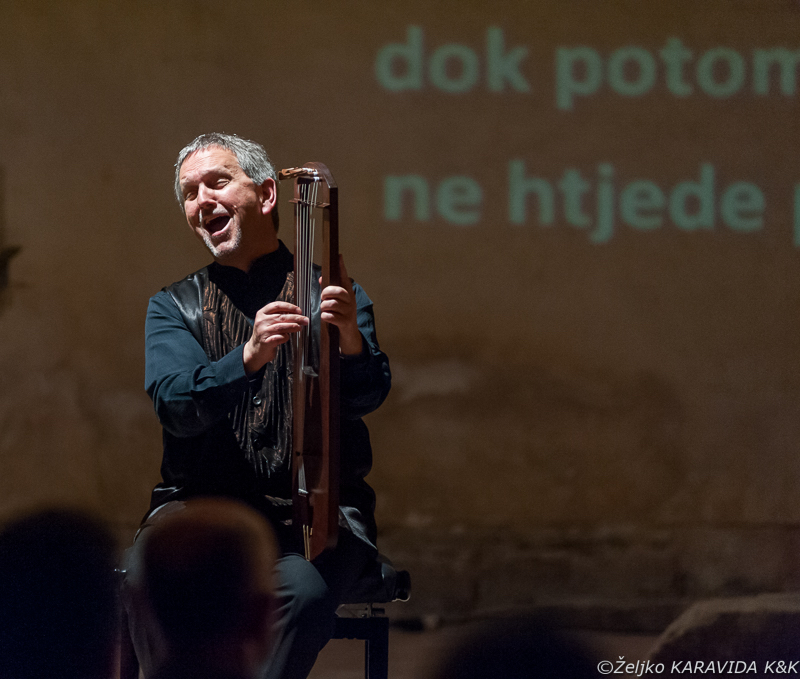
Beowulf, performance in Zadar, Croatia (2015)
A brief history of the Beowulf project (1990-2025)
Benjamin Bagby
I was first transfixed by Beowulf in a suburb of Chicago in the early 1960's, when my English teacher, Mrs. Bennett, handed me Burton Raffel's translation of the poem and laconically said 'you need to read this' (she later handed me yet another bombshell: Dante's Inferno). Perhaps it's not a coincidence that a few years later, in high school, I was utterly swept away by the sound of medieval music and started my first ensemble. The Anglo-Saxons would say that this was simply my wyrd (personal destiny).
In 1981, Sequentia (the medieval music ensemble I co-founded with Barbara Thornton) was invited to give a concert in Louvain, Belgium, as part of a university colloquium about performing historical vocal music. One of the participants in the colloquium was the Anglo-Saxonist Thomas Cable (University of Texas/Austin), who had recently published a book entitled The Meter and Melody of 'Beowulf,' discussing the theoretical background for various possible modes of performance. We began to talk, and our discussions, along with my close collaboration with Vermont harp-builder Lynne Lewandowski, sowed the seeds for making the Beowulf story into a performance. The sound-image for this performance popped into my head a few months later, as I was driving through rural Arkansas one blustery March evening; perhaps my subconscious was prodded by the omnipresent local images of razorback hogs, kin to the wild boar, those symbols of fearlessness so dear to the Anglo-Saxons. An instrument was ordered and built, and the project slowly took musical shape, at first making use of shorter Old English poems (such as Caedmon's Hymn and Deor) and later expanding into a short scene from Beowulf, which had its first public performance in 1987 and was integrated into a Sequentia concert program of medieval English music. Initial guidance with the intricacies of Anglo-Saxon pronunciation and meter was generously provided by Thomas Cable, during several memorable working sessions in his stone library-tower in Austin.
In 1990, I was approached by Jan Nuchelmans, then artistic director of the Utrecht Early Music Festival (Netherlands), about the idea of programming 'an entire evening of Beowulf' as part of the festival's storytelling theme that summer. How could I possibly say no? With less than 5 months to put together a performance lasting about an hour (there were numerous deletions in the text necessary due to festival time constraints and, strangely, the last departure times of Utrecht buses & trams following late-night concerts), I worked feverishly to solve the many problems of shaping an 'epic' performance instead of a 10-minute 'song'. This work was all accomplished with harp in hand and without the use of musical notation, and it was in this process of finding a new oral tradition to reconstruct a lost oral tradition that the project has its deepest roots. Following the premiere in the tiny crypt of the medieval Pieterskerk in Utrecht, this was the version of the story which I subsequently performed throughout Europe and North America during the mid-1990's.
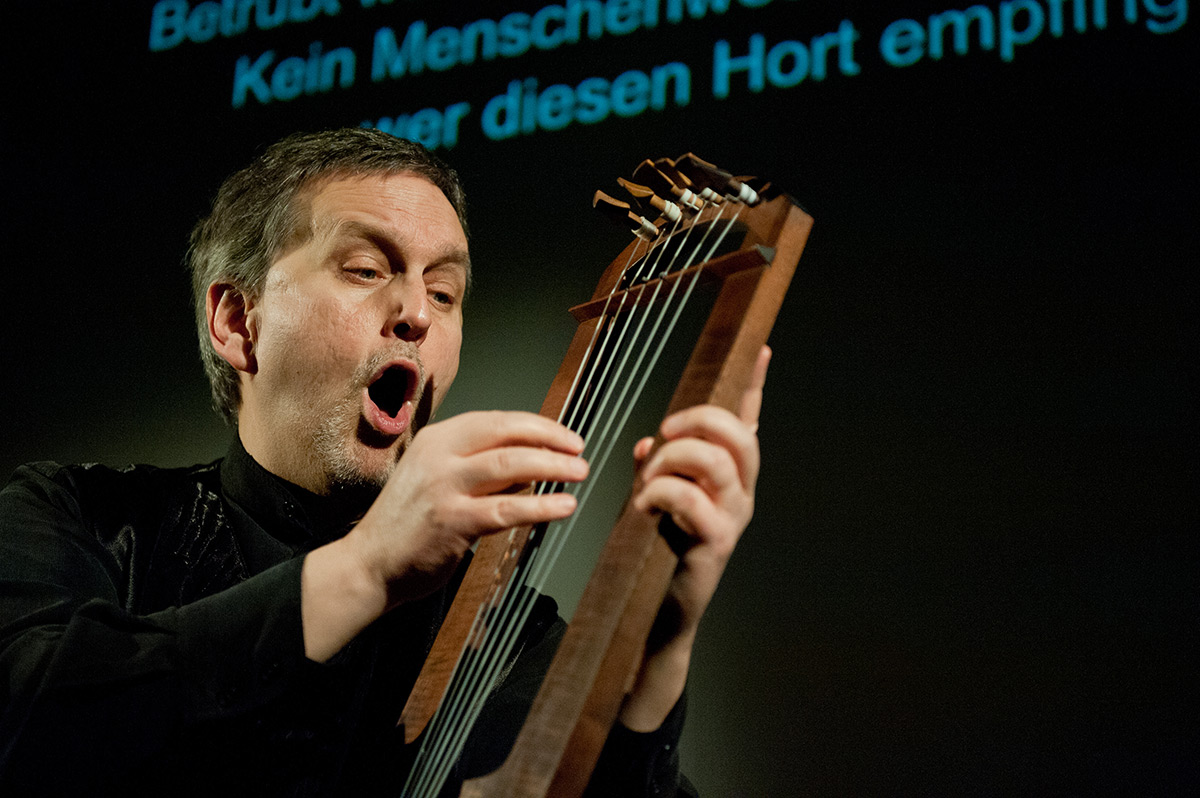
Beowulf, performance in Basel (2011). Photo: Susanne Drescher
With the Lincoln Center Festival's invitation to give a series of performances in New York, in 1997, the project received a huge boost in energy and interest. And it was during those subsequent difficult years 1997-2000 – which witnessed the long illness and death of my partner Barbara Thornton and the uncertainty of Sequentia's future – that the Beowulf project took on a new importance and urgency: the memorization process was completed, deleted sections of text were restored, new instruments were acquired, and video titles were used for the first time (1999). Sequentia's long-time agent Jon Aaron became the producer of the Beowulf project and gained an expertise in Anglo-Saxon which allowed him to effortlessly run the video titles from his offstage laptop.
In the meantime, I have performed Beowulf hundreds of times, between Vancouver Island and the Faroe Islands; synagogues in Poland and the Lower East Side of New York; a warehouse in Los Angeles and the Moscow Conservatory; Perth, Pittsburgh and Perugia; the MET Cloisters and the Sydney Opera House; a high school in rural Texas, Tel-Aviv and the Cité de la Musique in Paris. I have had much recent help with the text from John Miles Foley (University of Missouri/Columbia), the distinguished Anglo-Saxonist and scholar of oral poetry, who also oversaw the filming of the DVD in Helsingborn, Sweden, in 2006.
I was often asked if I had planned to learn and perform the entire epic. In fact, during 2002 discussions were started about the possibility of preparing the complete Beowulf (3182 verses, or a performance time of roughly 5 hours) for a group of co-commissioners in the U.S., but sufficient interest and funding could not be found to make possible the development of such an intense, long-term project. The idea was reluctantly abandoned in 2004, but not before I had worked my way well into the scene with Grendel's mother.
Responding to the Lincoln Center Festival's invitation to return with Beowulf in 2006, I decided to expand my performance to include the final 20 minutes of the first episode (Beowulf's defeat of Grendel and the subsequent celebrations), thereby making 'Part I' complete and containing the uncut text of lines 1-1062, the same version as was released on DVD. This is the version which I performed most widely in the period 2006-2025.
The DVD made in Sweden is now 20 years old, and there is much that I would do differently today. But it is what it is and I am happy to live with all the recordings made over the years.