The Wanderer
Songs of Travel from the Early Middle Ages
Benjamin Bagby: voice & harp, direction
Norbert Rodenkirchen: medieval transverse flutes
Translations of the sung texts will be projected as surtitles during the performance.
Travel during the Middle Ages was always slow and dangerous. Whether a voyage between continents or just a simple trip to the next village, religious shrine or market, the relative security of travel which we take for granted did not exist. Aside from knights and other fighting men, ministeriales, monks and clerics, merchants were on the road or on the water, buying and selling their products, followed by entertainers of all kinds – jongleurs, storytellers and musicians, but also the actors known as mimi, with their notoriously bad morals. Spiritual voyagers made pilgrimages to holy places (Rome, Canterbury, Jerusalem or Santiago de Compostela), or just imagined those voyages, and every traveler invoked the protection of some higher power. But a voyage could also be allegorical, teaching the listeners about the inner voyage to redemption and self-knowledge. In the northern, pagan worldview, the body and soul of a dead king traveled to his final resting place, taking an unknown route. The cold northern seas carried battle-hardened men fleeing from trouble or searching for a friendly shore. Our program explores some of these facets of the medieval traveler and his world.
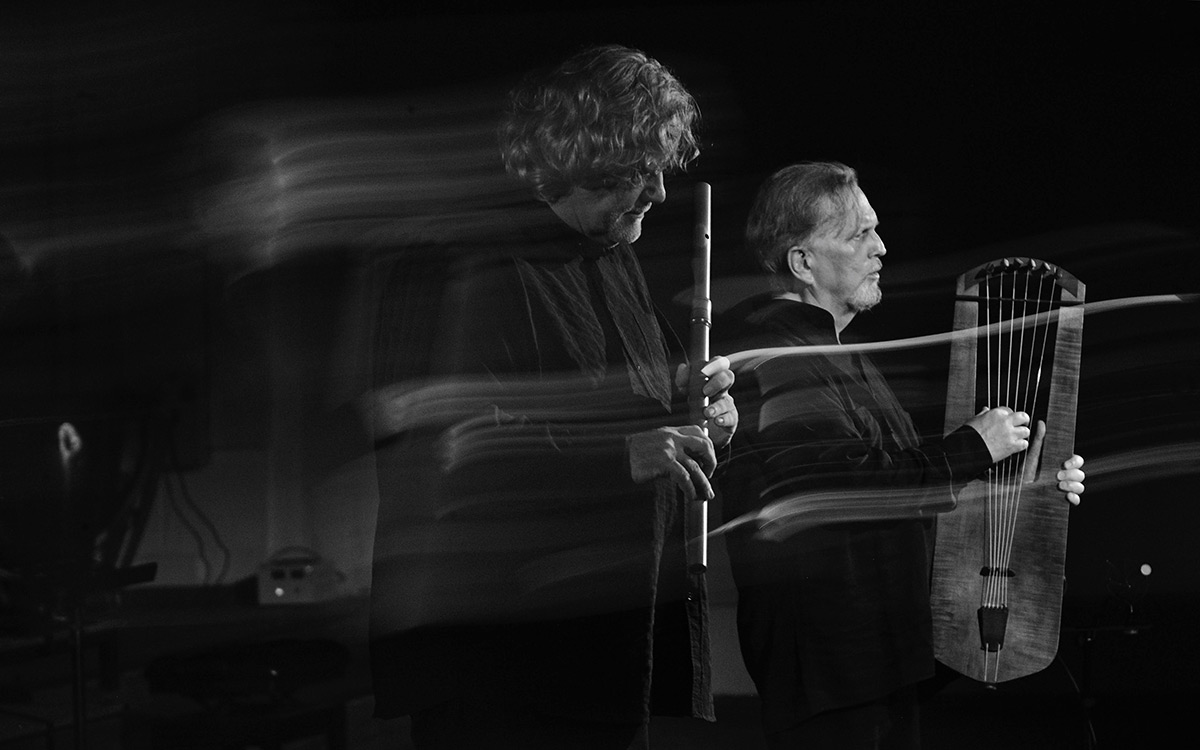
Norbert Rodenkirchen, Benjamin Bagby
Travel during the Middle Ages was always slow and dangerous. Whether a voyage between continents or just a simple trip to the next village, religious shrine or market, the relative security of travel which we take for granted did not exist. Aside from knights and other fighting men, ministeriales, monks and clerics, merchants were on the road or on the water, buying and selling their products, followed by entertainers of all kinds – jongleurs, storytellers and musicians, but also the actors known as mimi, with their notoriously bad morals. Spiritual voyagers made pilgrimages to holy places (Rome, Canterbury, Jerusalem or Santiago de Compostela), or just imagined those voyages, and every traveler invoked the protection of some higher power. But a voyage could also be allegorical, teaching the listeners about the inner voyage to redemption and self-knowledge. In the northern, pagan worldview, the body and soul of a dead king traveled to his final resting place, taking an unknown route. The cold northern seas carried battle-hardened men fleeing from trouble or searching for a friendly shore. Our program explores some of these facets of the medieval traveler and his world.
About the instrumental pieces
The earliest sequences first appear during the Carolingian period in the 9th century and became a very popular creative genre of medieval music production over the next 6 centuries. In the earlier times of that repertoire up to the 11th century they were written down and referred to in many cases in a textless form as well; just the pure melody in neumes. These textless melodic schemes are called "sequelae" or "melodiae longissimae". Many of them had fantasy names or instrument titles written down in the manuscript, like "Symphonia", "Fistula", "Cithara" etc. The reason for the use of these titles and the documentation of the textless melody remains unclear because the titles had nothing to do with the liturgical texts of the sequences which were sung to a particular melody. They indicate a secular use of the pre-existing tunes in a performance practice outside of a religious context. In some cases they clearly hint at instrumental performance. Sequentia presents instrumental versions of these "melodiae longissimae" and of early secular melodies which become ornamented and extended by idiomatically informed improvisation.
Him tha Scyld gewat
The royal ship burial of Scyld Scefing, from the Old English Beowulf epic (anon., 8th century)
The program begins with a voyage to the hereafter: Him tha Scyld gewat, a description of a royal ship burial from the Old English Beowulf epic (anon., 8th century). Tribal warriors carry the body of their beloved leader Scyld to his ship and cover him with treasure and weapons, before pushing the ship out onto the open sea. As it disappears over the horizon, they sadly reflect that no man can say where that final voyage will end.
Source: British Library, Cotton Vitellius A. XV / reconstruction B. Bagby
Iam dulcis amica
Instrumental version of a well-known Goliardic tune (10th c.)
Source: Paris, Bibl. nat., lat 1118. Transcription Benjamin Bagby / Reconstruction: Norbert Rodenkirchen
Ic me on thisse gryde beluce
An Anglo-Saxon prayer before a voyage (9th-century)
This 9th-century Anglo Saxon prayer before a voyage, Ic me on thisse gryde beluce, is Christian in content but certainly has its roots in pre-Christian incantations and charms, in which saints, angels and apostles replace the old gods.
Source: Cambridge Corpus Christi College 41 / reconstruction B. Bagby
Fistula
Ex-tempore version for flute solo, based on a textless sequela attached to the sequence 'Alma chorus' (Echternach, 11th century)
Source: PBN 10510 transcription and arrangement N. Rodenkirchen
Hwæthere ic me ealles
The exile's lament (England, 9th century)
A fragment from Anglo-Saxon sources, this lament of an exile calls to mind the many lost souls who have wandered the earth, driven from their homes and searching for a safe place to live, remembering the friends lost while searching for a boat to safety, without any gold to pay the passage, enduring hard fate.
Advertite, omnes populi, ridiculum
The 'Story of the Snow-Child' (Rheinland 10th or 11th century)
There are many sung stories about traveling merchants, but one of them is an anomaly: the ridiculous and tragic story of the snow-child, Advertite, omnes populi, ridiculum. In this voyage of vengeance and the double-betrayal of a cruel Swabian merchant and his lascivious wife (and some seductive traveling entertainers), we are reminded of the loneliness and vulnerability of those the traveler leaves behind, and the uncertain fate of children. This anonymous story was popular in the Rheinland (where jokes about Swabians found a ready audience) and survives in a manuscript of the early 11th century.
Source: Cambridge, University Library, MS Gg.5.35 / reconstruction B. Bagby
Wolfenbuettel – Nota
A textless tune in neume notation (Wolfenbüttel, 11th-century)
Source: Wolfenbüttel cod guelf 79 10v / transcription N. Rodenkirchen
Oft ic anhagan
An Anglo-Saxon elegy known as 'The Wanderer' (England, 10th century)
This is the most famous of the Anglo-Saxon elegies known today simply as 'The Wanderer' (anon. 10th century). We hear the secret thoughts and fears, memories and melancholy reflections of a solitary warrior who has lost his people, his friends and his protector. He travels the cold northern seas in search of a new home, and cries out for the loss of the world of comfort, goodness, security, beauty and friendship which he once knew.
Source: Exeter Book, Exeter Cathedral Library MS 3501 / reconstruction B. Bagby
Vaga varia
Ex-tempore version for flute solo, based on a textless sequela attached to the sequence 'Laus inclita' (11th century),
Source: Winchester Tropers, CC 743, transcription N. Rodenkirchen
Welund him be wurman
The Anglo-Saxon elegy called 'Deor' (10th century)
The elegies are laments over the loss of a spouse, a child, a homeland, a dying culture. The elegiac speaker often ponders her or his past, wondering just how real the memories of an earlier life, now lost, might be. These poems bring to life an ancient language and culture and reaffirm the connection between past and present.'Deor' gives us a glimpse of the working world of the medieval tribal singer (the scop). He calls to mind a pastiche of images from the well-known myths in his songbook before singing about himself and his own sad situation: recently replaced by a rival singer, Deor is once again a wanderer. His resignation is profound and yet filled with quiet acceptance.
Source: Exeter Book, Exeter Cathedral Library MS 3501 / reconstruction B. Bagby