Voices from the Island Sanctuary
Ecclesiastical Singers in Paris (1180-1230)
Benjamin Bagby:voice, harp
Justin Bonnet: voice
Josep Cabre: voice
Vincent Pislar: voice
Wolodymyr Smishkewych: voice, organistrum
Michael Loughlin Smith: voice
Duration: 75 minutes with or without intermission. Translations of the sung texts can be video-projected during the performance (English, French and Dutch available).
Introduction
For centuries, Parisians and visitors to Paris have been thrilled by the imposing Cathedral of Notre Dame, whose massive towers and elegant flying buttresses dominate the Ile de la Cité. We perceive the cathedral as a large church, a single building surrounded by city streets, kitschy souvenir shops, overpriced cafés, a park with romantic benches for lovers, and the long lines of tourists waiting to climb the towers. But in the 12th century, the cathedral of Notre Dame was situated within its own 'campus', a vast complex of interconnected buildings (including several smaller churches) surrounding the cathedral itself, all encircled by a wall and enclosing almost one full third of the island. Within these walls (the 'close' of the cathedral precinct) there existed an autonomous mini-state, with its own laws and enforcement, free from the secular power wielded by the French king residing nearby; with housing and meals for the hundreds of clerics who worked and lived there; with an army of servants to keep the whole place operating smoothly; with students from many countries following lectures in theology and philosophy; with aristocratic churchmen called canons, managing their vast estates and political intrigues from comfortable dwellings within the close.
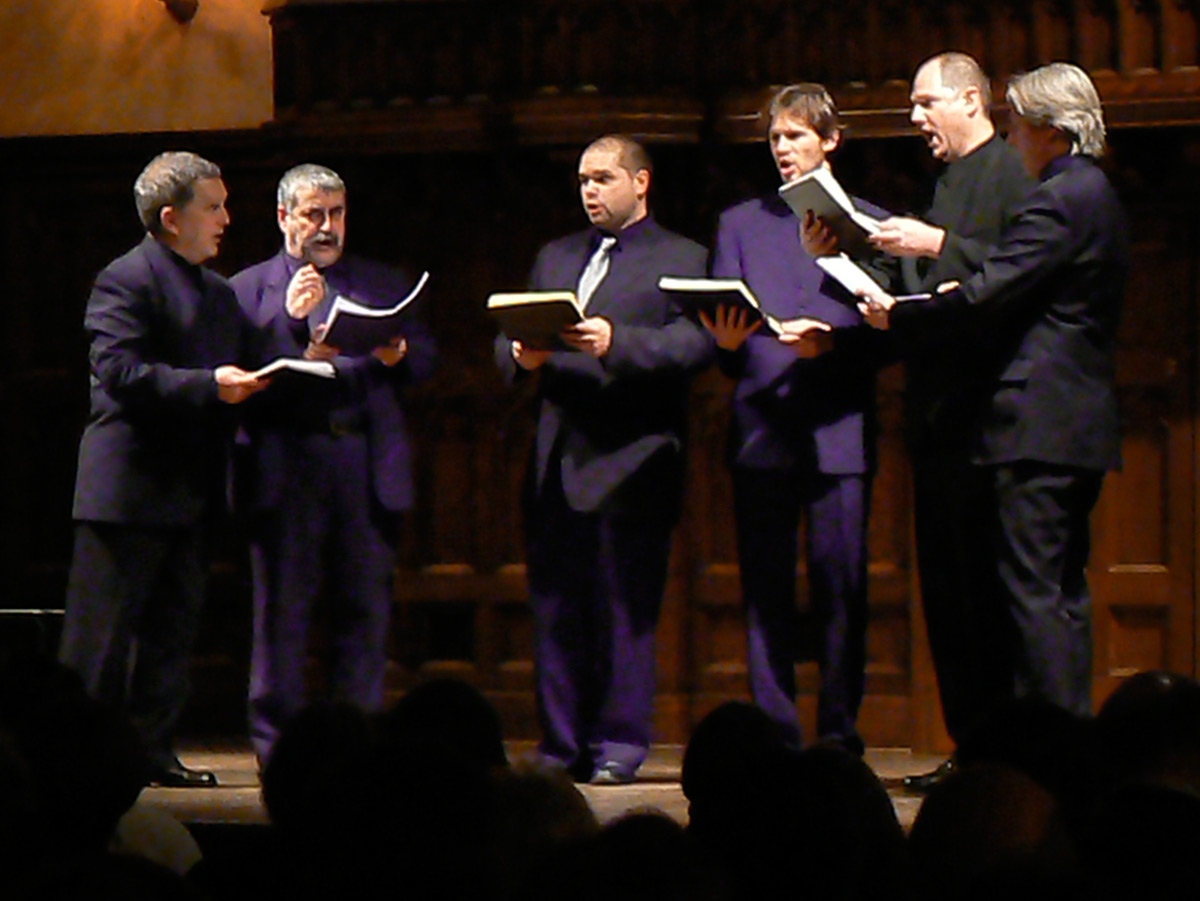
'Voices from the Island Sanctuary': left to right: Benjamin Bagby, Josep Cabre, Wolodymyr Smishkewych, Mathias Spoerry, Vincent Pislar, Michael Loughlin Smith.
There was a school for the choirboys, a private port on the Seine, and the palace of the archbishop himself, where important guests were entertained and where the brightest, most ambitious spirits of learning and the arts were able to demonstrate their virtuosity. Latin – spoken and sung in a variety of accents and with varying degrees of elegance – was the official language of the community, but courtly French could also be heard, and the rude dialect of the city was heard among servants and workmen. Construction on the new cathedral continued throughout this period (the present structure was begun in the 1160's and the towers were not finished until at least 1250) and the dust and noise of the masons was omnipresent. The cathedral itself was at the heart of this city within a city, and deep within the cathedral was yet another walled precint: the choir before the high altar, where the singing of the mass and offices was carried out night and day by a large number of canons and lesser clergy who were rewarded in return for this service. It was also in this enclosed space that the best young male vocalists in Europe were to be heard on important feast-days; it was here that the most innovative musical minds gave expression to new ideas in thrilling sonic structures which echoed the dynamic new architecture taking shape around them.
Programme
Ave gloriosa virginum regina (1v sequentia)
Philippe le Chancelier (d. 1236)
Passionate young urban males
Aurelianis civitas (1v conductus)
O varium fortune lubricum (2v conductus)
Initium sancti evangelii secundum marcas argenti (Gospel parody)
Curritur ad vocem nummi (3v conductus)
Anglia planctus itera (1v conductus/planctus)
Bulla fulminante (3v conductus trope)
New sounds in Parisian churches
Descendit de celis (2v organum on responsory chant) Paris, Notre-Dame, (ca.1200)
Minor natu filius (1v conductus) Philippe le Chancelier
Zima vetus expurgetur (1v sequence) Paris, St.Victor, (mid-12th century)
Eros and ambition
Sic mea fata (1v latin song)
Veneris prosperis (2v conductus)
Vitam duxi (1v conductus)
Procurans odium (3v conductus)
Olim sudor Herculis (1v sequence, with refrain) Pierre de Blois (d. 1212)
New Year's Day
Festa ianuaria (3v conductus)
Annus renascitur (1v conductus)
Novus annus hodie (3v conductus)
Sources: With a few exceptions, the music for this programme is taken from the most important source of medieval Parisian vocal music: Florence, Bibl. Mediceo-Laurenziana, pluteo 29,1 (copied in Paris sometime after 1255). The responsory chant Descendit de celis is from a late 13th-century Parisian chant book (source: Paris BN lat. 15181). The text to Curritur ad vocem nummi is taken from Munich, Bayerische Staatsbibliothek, Hs. clm 4660 ('Carmina Burana'). The performers are singing from facsimiles of this mss. or from transcriptions prepared by Benjamin Bagby. The Victorine sequence Zima vetus expurgatur (source: Paris, BN lat. 14819) is performed from a transcription by Margot Fassler.